AI personalisation driven by customer behaviour lifts revenue per customer by an average of 15 to 20 percent according to McKinsey, and cross-sell adds another 10 to 30 percent of turnover. Most stores still do not do it, because they do not own the behavioural layer and, behind a cookie banner, only see a fraction of their visitors. Behio solves that with smart offers: a discount that appears, say, to a visitor who has been on a product five times and not bought. A rule also starts in a silent watching mode and shows you how many people it would have hit before you give away a single crown.
Comparison table
Compare the scope and terms described in this article.
| Approach | Targeting | Effect |
|---|---|---|
| Blanket discount for everyone | nobody in particular | gives up margin even where they would have bought |
| First name in an email | cosmetics | minimal |
| Behavioural discount | one specific stuck decision | 15 to 20 % per customer (McKinsey) |
| Price personalisation | based on profile | falls under EU Omnibus, must be disclosed |
Effect figures come from McKinsey research and retail benchmarks. Unlike a bonus discount, price personalisation has to be disclosed to the customer under EU rules.
What behavioural personalisation is
Personalisation does not mean putting a first name in an email. That is cosmetics. Real personalisation reacts to behaviour: what somebody looked at, how many times they came back, what is in their cart, whether they have ever bought before. From that you can infer intent and offer exactly the thing that moves them towards a purchase.
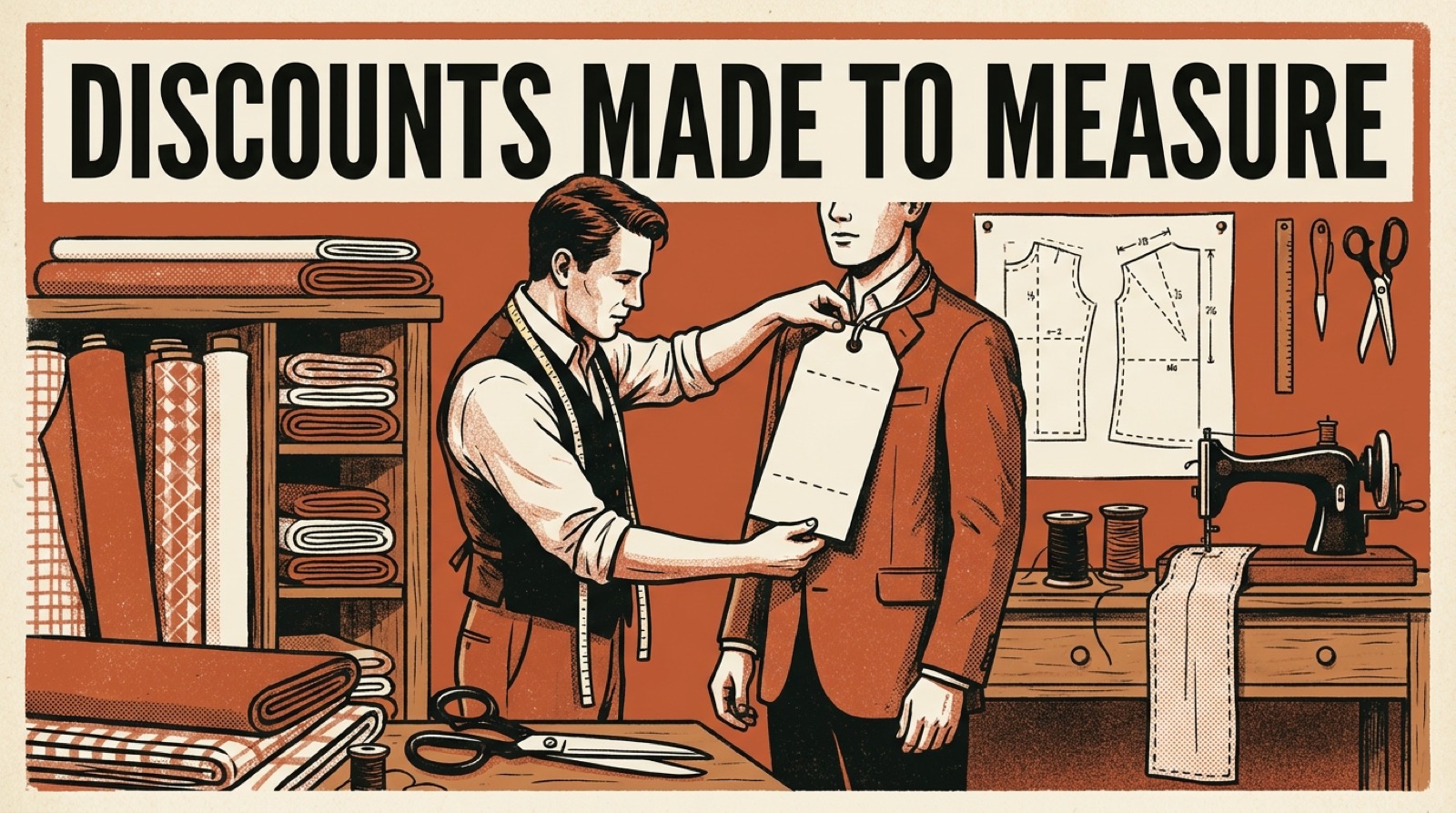
The classic example. Somebody comes back to the same jacket five times in a fortnight and never orders. It is not the price of the category holding them up, it is that one jacket, and something is stopping them. A targeted fifteen percent discount on that jacket at that moment works better than a blanket sale for everybody, because it aims at one specific stuck decision.
What personalisation actually adds
The numbers are not small. According to McKinsey, AI personalisation lifts revenue per customer by an average of 15 to 20 percent, and targeted cross-sell and upsell add another 10 to 30 percent of turnover. Personalisation engines show returns of around 2.7 times the money put in, and 69 percent of retailers with AI deployed report a measurable revenue increase.
More telling still is the gap in conversion by type of customer. A returning visitor converts at roughly 4.5 to 6 percent, a first visit at only 1 to 2. Working with interest that is already coming back is a cheaper road to revenue than chasing yet more new visitors. And returning interest is exactly what personalisation aims at.
In B2B the pressure is stronger again. Around 66 percent of business buyers now expect fully personalised content, and companies that excel at personalisation report conversion rates up to 40 percent higher. Whether you sell to consumers or to companies, the conclusion is the same. Personalisation is ceasing to be a bonus layer and becoming an expectation, and when you fail to meet it the customer notices and goes somewhere they are treated as a specific person rather than an anonymous visit.
Why most stores never do it
Personalisation needs reliably captured events and rules consistent with visitor consent. Behio can connect those events with the catalog and supported Smart Offer conditions. Available data and configuration determine the scope.
The second obstacle is that even with the data you need a layer that can turn it into an action in real time. Measuring interest is one thing. Converting it into the right offer at the right moment is another. Most tools can either measure or send emails, but not connect the two. That is the hole, and few people fill it.
How Behio's smart offers work
Behio Analytics connects captured traffic events with orders recorded by the platform. Cookieless measurement does not mean every visitor is captured; event completeness and source attribution depend on setup, consent and available data. Use those events to configure smart offers within supported rules and your plan.
The cleverest part is the safety mechanism. A rule starts in watching mode. It gives nothing away, it simply counts how many people would have been hit over seven days. You see the money on the table before you hand over a single crown, and you switch the offer on with one click. The discount code is single use, tied to both the product and the individual visitor, so a leaked code is worthless. And once a purchase happens the offer is marked as redeemed, so you can measure the return. We show what that looks like in practice in the story of one smart offer.
Where the line is, and the ethics
Personalisation has limits and it is fair to know them. Price personalisation, meaning the same product shown to different people at different prices based on their profile, falls under the EU Omnibus directive and you have to tell the customer about it. Outside the EU the rules differ, so check what applies where you sell. A smart offer as a targeted discount on top of the standard price is a different thing from quiet price discrimination, and the two are worth keeping apart.
To my mind the healthy line is simple. Rewarding interest with a bonus is fine and customers read it positively. Quietly punishing somebody with a higher price because they look willing to pay more is short sighted and it breaks trust. Personalisation should add value, not squeeze.
The verdict
Behavioural personalisation is one of the few things where the data plainly says it pays, and 15 to 20 percent more per customer is not a rounding error. Most stores still do not do it, because they do not own behavioural data and, behind a cookie banner, only see half their visitors. Whoever owns that layer can turn repeated interest into orders with a targeted discount at the right moment. For me the cleverest part is the watching mode, which shows you the money on the table before you give anything away. And I would hold the line clearly: reward interest, yes. Punish quietly with price, no.
Common questions
According to McKinsey, AI personalisation lifts revenue per customer by an average of 15 to 20 percent, and targeted cross-sell and upsell add another 10 to 30 percent of turnover. Personalisation engines show returns of around 2.7 times the money invested.
Personalisation needs reliably captured events and rules consistent with visitor consent. Behio can connect those events with the catalog and supported Smart Offer conditions. Available data and configuration determine the scope.
Automatic personal discounts driven by behaviour. A rule combines scope, trigger and action, for instance offer fifteen percent on a specific product to somebody who has viewed it five times and not bought. The code is single use and tied to both the product and the visitor, so a leaked code is worthless.
A rule in Behio starts in watching mode. It gives nothing away, it only counts how many people would have been hit over the period. You see the money on the table before handing over a single crown, then switch the offer on with one click. After a purchase the offer is marked as redeemed, so you can measure the return.
Price personalisation, where different people see the same product at different prices based on their profile, falls under the EU Omnibus directive and has to be disclosed to the customer. Outside the EU the rules differ. A targeted discount on top of the standard price is a different thing from hidden price discrimination, and the two are worth keeping apart.
Build a store that never surprises you on the invoice.
Your own store, a clear admin and Tom there to help. Choose the features your business needs and try Behio free for 14 days without a card.