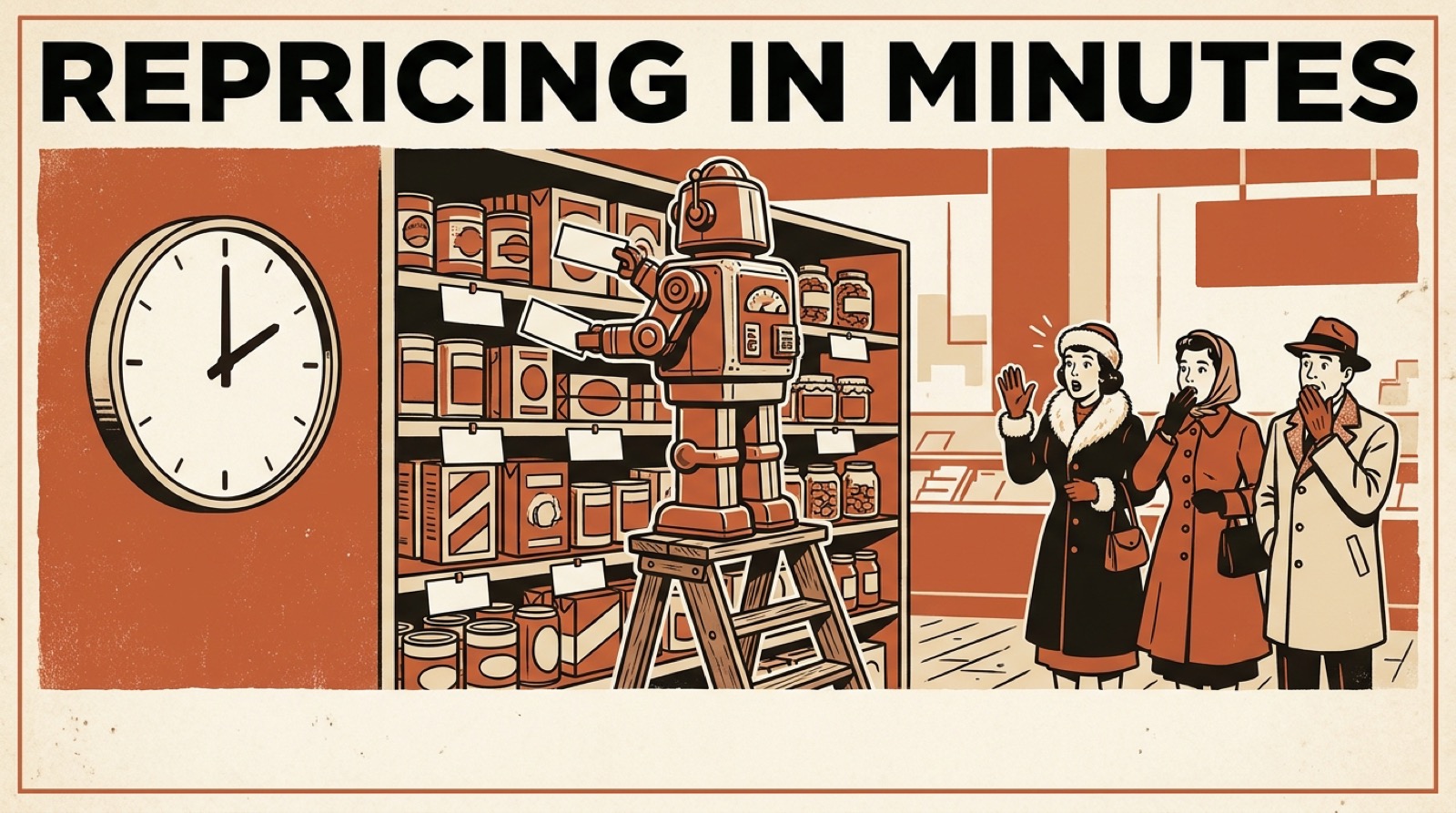
Repricing a catalogue in bulk, which by hand means half a day in spreadsheets, takes Tom in Behio a few minutes. He calculates the margin from cost and selling price, finds underpriced products and works out how much to raise them by so the margin lands where you want it. But he never rewrites prices on his own: first he shows an overview of old and new prices and waits for your confirmation. The figures below are a model example for the sake of illustration, not the data of any particular store. It is that pairing, the speed of a machine with the control of a human, that makes repricing a safe operation rather than a gamble with your margin.
Comparison table
Compare the scope and terms described in this article.
| Step | By hand | With an AI partner |
|---|---|---|
| Calculate margins across the catalogue | hours in spreadsheets | seconds over the data |
| Find underpriced products | easily missed | lists all of them |
| Apply a rule to prices | error prone retyping | calculation without typos |
| Make the change | manually, risk of error | only after your confirmation |
| Report on the impact | extra work | part of the output |
The numbers in this article are a model example for the sake of illustration, not the data of any particular store. Tom always carries out a bulk price change only after a human confirms it.
Your supplier put prices up, now what
An email arrives from a supplier: from next month we are raising prices by eight percent. And through your head runs the tedious work behind that sentence. Open the price list, go through hundreds of products, work out on each one how far the margin drops and decide how much to raise the selling price. Half a day in spreadsheets, plus the fear that you will fat finger something somewhere and sell below cost.
This is work made for AI. Fast, arithmetical, repetitive, with clear rules. Let me show you what bulk repricing looks like with Tom and why it is minutes rather than half a day. And a fair note up front: the figures below are a model example for the sake of illustration, not the data of any particular store.
Analysis first, not intervention
Repricing does not start with changing prices, it starts with seeing where you stand. Tom goes through the catalogue and calculates the margin from cost and selling price on every product that has a cost price filled in. Out of that falls a picture of where margin is healthy and where it is thin, and above all where the cost price has moved since the last edit and the margin collapsed without anybody noticing.
Model example (not the data of any real store): out of eight hundred products, sixty have a margin under fifteen percent and on twenty of those the cost price has gone up over the past six months. That is the starting picture. Not a single price has been touched, this is pure analysis from data. And that analysis is the foundation, because repricing blind is worse than not repricing at all.
You set a rule, not individual prices
This is where the strength of a bulk operation shows. You do not enter a price product by product, you enter a rule. Something like I want at least thirty percent margin on the accessories category. Or pass a supplier's eight percent increase through to the selling prices for that brand. Tom takes the rule and works out what it would mean for every affected product separately.
Model example (not the data of any real store): the rule of at least thirty percent margin on accessories touches forty six products, whose selling price would rise by an average of forty one koruna, and by up to one hundred and twenty on the most underpriced. Those amounts are in Czech koruna, since Behio's home market is the Czech Republic, and what carries across borders is the ratio rather than the sum. That is a calculation which by hand takes an hour across fifty items and produces mistakes. Tom does it in seconds and without typos.
The last word is yours
Now the part that makes repricing with AI safe rather than frightening. Tom never carries out a bulk price change off his own bat. Before he touches anything he sends you an overview of old and new prices for approval. You see exactly what happens to which product, and only once you sign off do the prices get rewritten.
Around money that strikes me as the only correct behaviour. The calculation and the preparation, which is the dull and error prone work, goes to the machine. The decision about whether it actually happens belongs to a human. No silent consent, no repricing behind your back. Anyone who wants to see that dialogue step by step will find it in the article on what AI finds when it goes through a catalogue.
Raising a price is not the only route
Repricing is not always about putting prices up. On slow moving items you do not want to raise the price, you want to clear them so they release stock and cash. From sales data Tom finds the laggards and proposes a targeted time limited discount on that set alone, rather than across the whole catalogue. Different tool, different problem.
And then there is a cleverer variant than a blanket discount. Smart offers send the discount only to the visitor who demonstrably keeps coming back and still has not bought, so you are not giving margin away to people who would have bought anyway. How behaviour turns into a targeted discount is covered in the article on smart offers. Repricing, clearance and a targeted discount are three levers, not one.
What AI does not decide about pricing
So this does not come across as AI running your pricing. It does not. It will not decide whether you want higher margin or lower prices and greater volume, that is your strategy and your knowledge of the market. It does not know that a competitor is launching a clearance tomorrow, or that you hold a low price on this brand deliberately as a draw.
What it can do is take the arithmetic off your plate, find the underpriced items and apply a rule flawlessly across hundreds of prices. That is half a day of work handled in a few minutes. The decision and the sign off stay with you. Around money that is how it should be. The speed of a machine, the control of a human. Hold that line and you gain tempo without the risk of quietly breaking your own margin.
The verdict
Bulk repricing is textbook work for AI: fast, arithmetical, repetitive and governed by clear rules. Tom in Behio calculates margins across the whole catalogue, finds underpriced items, applies your rule to hundreds of prices without typos and turns it into a report, all in a few minutes instead of half a day in spreadsheets. But he never rewrites prices himself: he shows the old and the new and waits for your sign off. The numbers above are deliberately illustrative. It is exactly that pairing, the speed of a machine with the control of a human, that makes repricing a safe operation. And raising prices is not the only route, clearance and a targeted discount are two more levers Tom knows how to play.
Common questions
Minutes. Tom calculates margins across the whole catalogue, finds underpriced products and applies your pricing rule to hundreds of prices in seconds. By hand it is half a day in spreadsheets plus the risk of typos. The speed comes from the AI reading and calculating the data directly in the platform.
Yes, because Tom never rewrites prices on his own. First he calculates the impact, shows an overview of old and new prices and makes the change only after your confirmation. The machine does the calculation and the preparation, the human signs off. Which is why there is no repricing behind your back.
No. Every value in the article is a model example for the sake of illustration, not the data of a particular store. On your side Tom calculates from your real cost and selling prices, so the result will be different.
Yes. On slow moving items Tom uses sales data to propose a targeted time limited discount on that set alone, rather than across the board. Repricing upwards, clearance downwards and a targeted discount through smart offers are three different levers for three different situations.
No. Tom calculates the impact and applies your rule, but whether to go for higher margin or for volume and lower prices is your strategy. He also knows nothing about things outside the data, like a competitor's move or a deliberately low price on a draw product. The decision stays with you.
Build a store that never surprises you on the invoice.
Your own store, a clear admin and Tom there to help. Choose the features your business needs and try Behio free for 14 days without a card.