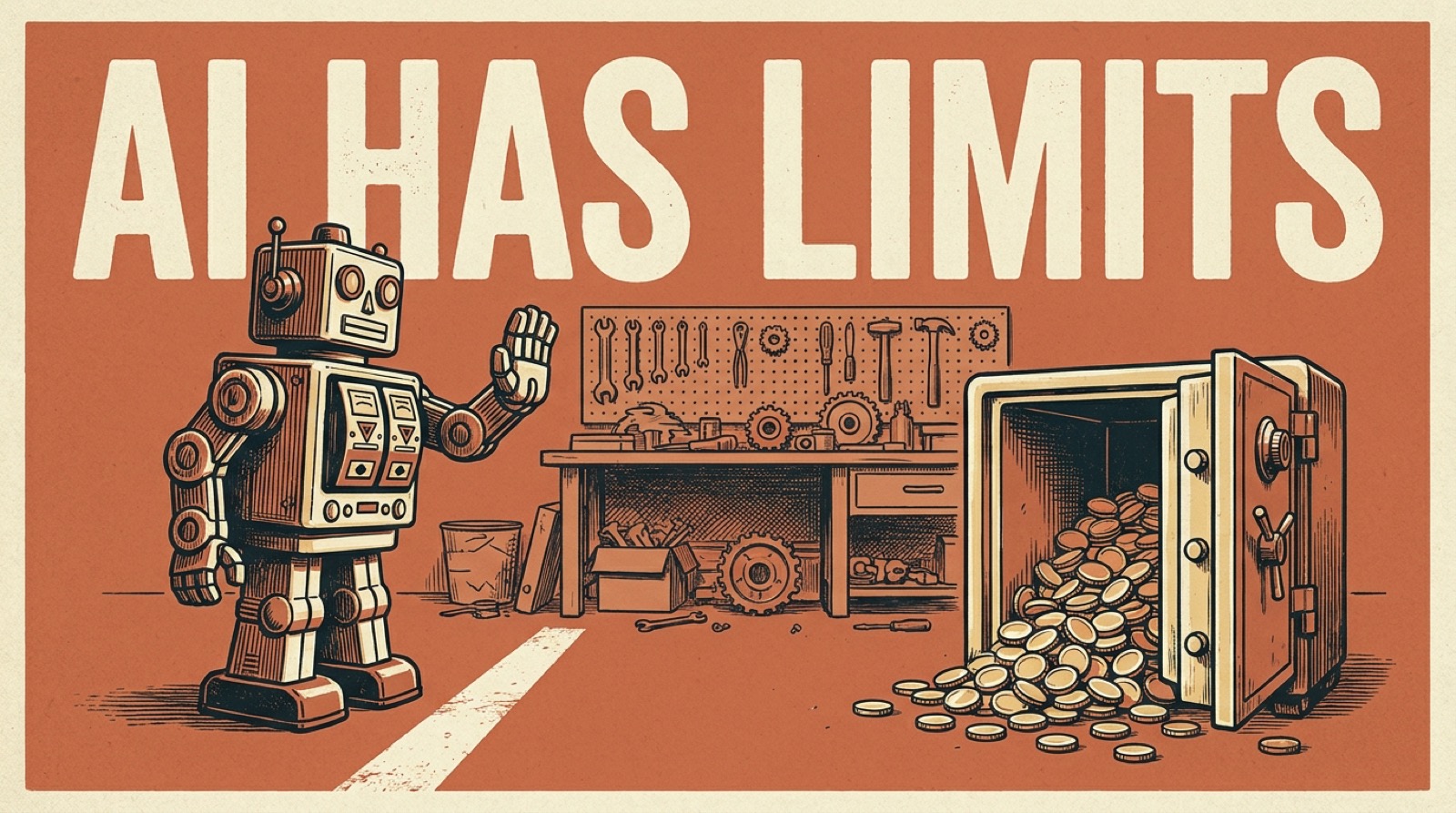
Good AI in a store is not the one that can do the most, it is the one that knows its limits. Tom in Behio does not do irreversible or sensitive things on his own: bulk price changes and deleting data happen only after your confirmation, commercial strategy and pricing stay with you, he will not conjure product photography, and delicate customer care around complaints and disputes goes to people. Safety is also built into the design, for instance a discount code from smart offers is tied to one specific visitor, so a leaked code is worthless. The limits of AI are not a weakness. They are the reason you can trust it with day to day operations.
Comparison table
Compare the scope and terms described in this article.
| Area | What AI does | Where its limit is |
|---|---|---|
| Money | issues an invoice, watches for payment | does not move money, does not touch accounts |
| Data | calculates the impact of a price change | does not overwrite or delete without confirmation |
| Strategy | prepares the groundwork and proposals | does not decide range and price |
| Copy | writes a draft description | sensitive claims are verified by a human |
| Customers | prepares history and background | complaints and disputes go to people |
This overview reflects how the features in Behio are designed as of 2026. The limits are deliberate, not missing functionality.
The question I get most often
When I show what an AI partner in a store can do, almost the same question always comes back. And what if it gets it wrong? What if it deletes something it should not, or sends out a discount I never wanted? It is the right question and I take it seriously, because trust rests on it.
Let me put it bluntly. Good AI in day to day operations is not the one that manages the most actions, it is the one that knows where to stop. We built Behio so that Tom can do a lot while keeping his hands off the trigger on irreversible and sensitive things. This article is about those limits, because to my mind they sell trust better than another list of features.
He does not move money or go around your accounts
The first and hardest limit is money. Tom does not transfer payments, does not send payouts and does not touch your bank accounts. He issues an invoice from an order and keeps an eye on whether payment arrived, but the movement of money itself stays outside him. That is deliberate, not a gap.
The same goes for connecting payment gateways and carriers. When you are setting up a provider, whether that is a Czech gateway like Comgate or GoPay, a carrier like Zasilkovna or whatever the equivalent is in your market, Tom prepares them for you but asks for your own account credentials to make the connection. He does not pretend he can wire up a gateway without your details, because those are your contracts with those providers. Where he asks for keys and where he does not is shown in the article on the road from an idea to a first order.
He does not delete or overwrite without confirmation
The second limit is irreversible changes to data. Tom will not carry out a bulk price change off his own bat. First he calculates the impact, shows you an overview of old and new prices, and rewrites the prices only once you have signed off. No silent consent. The same logic applies to anything that is hard to undo.
That strikes me as decent behaviour around both money and data. The analysis, the proposal and the impact calculation take AI seconds, and it is work nobody wants to do by hand. But the decision about whether it actually happens belongs to a human. We wrote up the whole dialogue, where Tom does the arithmetic on prices without touching them, in the article on repricing a catalogue.
He does not decide strategy or price
The third limit is commercial judgement. Tom will prepare the groundwork, calculate margins, show you what is not selling and suggest a clearance. But whether you go for higher margin or lower prices and greater volume, what range you carry and which market you enter, that is your strategy. AI knows nothing about things outside the data: that your supplier is raising prices next week, or that you are holding a low price because of a competitor.
Nor will it conjure the human parts that do the selling. Good product photography. An honest brand story in the copy. A feel for what your customers actually want. AI will write a decent first draft of a description, but a hero product carrying your revenue deserves a human hand. Where AI helps with copy and where it should stay out is covered in the article on generated product descriptions.
Sensitive things belong to people
The fourth limit is caring for a customer at the moment things go wrong. A complaint, a dispute, an angry person who is half right. There you do not want a template from a machine, you want a human who listens, admits a mistake and saves the relationship. AI can pull together the order history and the background, but that conversation is yours.
Sensitive claims belong here too, the ones people care about or that are regulated. Ingredients, safety, health effects, country of origin. An invented figure in a description is not weak copy, it is misleading the customer and it comes back as returns. Which is why a human writes and verifies those things, not a model. Responsibility for content always sits with the merchant.
Safety built into the design
The last point is not about what Tom does not do but about how the features are built so they cannot be abused. Take smart offers. The discount code is single use and tied not only to a product but to the specific visitor it was issued to. At checkout the server verifies that the right person is redeeming it.
In practice that means a leaked code is worthless. If somebody copies it onto a deals site, it will not work for anyone else. That is the difference from an ordinary coupon like SUMMER20, which turns up in every bargain hunting group within the hour and eats your margin. To me this is the right philosophy. Not hoping the AI and the customer will both avoid mistakes, but building things so a mistake or a leak does no damage. The whole mechanism is described in the article on smart offers.
The verdict
The best AI in a store is the one you can trust, and you can trust the one that knows its limits. Tom in Behio does not move money, does not overwrite or delete data without confirmation, does not decide strategy and price, leaves sensitive claims to be verified by a human and hands complaints to people. On top of that, safety is in the design: a leaked discount code is worthless, because it belongs to one specific visitor. I take that as a fair counterweight to enthusiastic promises about everything AI can do. It takes the routine off you and keeps its hands off the irreversible and the sensitive. Which is exactly why you can rely on it day to day.
Common questions
No. Tom in Behio does not transfer payments and does not touch bank accounts. He issues an invoice from an order and watches for payment, but the movement of money itself is outside him. To connect payment gateways and carriers he also asks for your own credentials, because those are your contracts with the providers.
No. Bulk price changes and other irreversible actions happen only after your confirmation, with the impact calculated and shown first. AI does the analysis and the proposal itself in seconds, but the decision about whether the change actually happens stays with a human.
No, deliberately so. Tom prepares the groundwork, calculates margins and suggests promotions, but commercial strategy, pricing and range selection stay with you. He knows nothing about things outside the data, like a supplier's coming price rise or a competitor's move.
It does not matter. Codes from smart offers are single use and tied to a specific visitor and product, and checkout verifies on the server that the right person is redeeming it. A leaked code is therefore worthless, unlike a blanket coupon that can be used across the whole store.
The opposite, in my view. Without limits you could not trust AI in day to day operations and nobody would let it near stock, prices or orders. It is precisely because Tom keeps his hands off the trigger on money, deletion and sensitive matters that you dare let him handle the enormous routine around them.
Build a store that never surprises you on the invoice.
Your own store, a clear admin and Tom there to help. Choose the features your business needs and try Behio free for 14 days without a card.