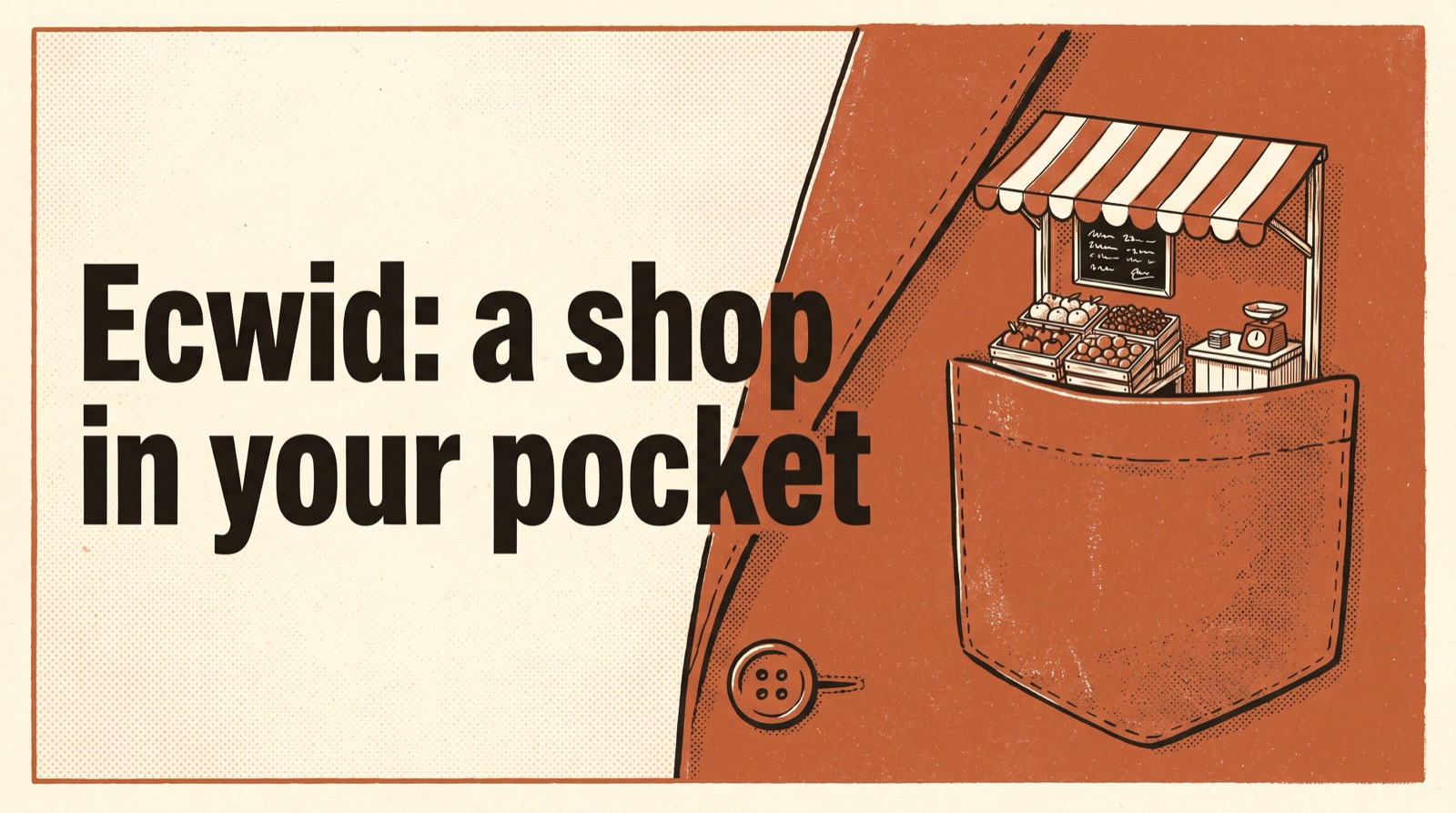
Ecwid (now Ecwid by Lightspeed) is not a classic online store but a widget you drop into any existing website, blog or social profile without rebuilding anything. It speaks 36 languages and handles every currency, which is its real strength. Since 2 March 2026 it has scrapped the free plan, so the cheapest entry is Starter at 5 USD a month with a limit of 10 products. For selling a few products alongside a site you already have and like, it makes sense. For a full store it runs into product limits, weak SEO and no native links to local carriers, gateways and comparison engines.
Comparison table
Compare the scope and terms described in this article.
| Plan | Price / month | Product limit |
|---|---|---|
| Starter | 5 USD | 10 products |
| Venture | 29 USD yearly / 35 monthly | 100 products |
| Business | 49 USD yearly / 65 monthly | 2,500 products |
| Unlimited | 119 USD yearly / 149 monthly | no limit |
Prices as of 2026 after the March 2026 change, excluding tax. The free plan was scrapped on 2 March 2026 and the cheapest entry is Starter at 5 USD. Ecwid charges no transaction fees, the payment gateway is billed separately.
A store that drops into a finished website
Most platforms want you to build an entirely new website. Ecwid goes the other way round and that is exactly its charm. It is a widget, an embeddable checkout and catalogue that you drop into a site you already own, whether it runs on WordPress, on Wix, or on hand written HTML. You rebuild nothing, you paste in some code and the page has a cart.
Ecwid is now owned by Lightspeed and is officially being renamed Ecwid by Lightspeed, with an option to connect Lightspeed POS for selling in a physical shop too. For a sole trader with an attractive website or blog who wants to bolt on a few products, this is the smallest possible change. You demolish nothing, you add.
Where Ecwid leads: languages and currencies
I have to give Ecwid one thing where it is ahead of most international platforms: localisation. The store and its so called Instant Site are fully translated into 36 languages, Czech and Slovak among them, it supports every official currency with automatic conversion based on the visitor's location, and it handles a GDPR cookie bar for European visitors.
That puts it among the best localised international platforms for smaller markets, at least as far as language goes. Against Squarespace or Wix, which either do not speak the language or bill in dollars, the difference shows. Careful though, language localisation is not the same as being wired into a local ecosystem, and that is where Ecwid is weaker. More on that shortly.
The free plan is gone, so you pay from day one
One important change landed in 2026. On 2 March 2026 Ecwid scrapped its free plan. A small store used to be possible at no cost, and now it is not. The cheapest entry is Starter at 5 USD a month, and it comes with a hard limit of 10 products.
Above it sits Venture at 29 USD a year (35 USD paid monthly) with a ceiling of 100 products and selling on Facebook and Instagram, then Business at 49 USD a year with a limit of 2,500 products and two staff accounts, and finally Unlimited at 119 USD a year with no product limit. Ecwid charges no transaction fee on any plan, you pay only your payment gateway's rates. Losing the free plan does mean committing money to Ecwid immediately, with no more trying it out for real at no cost.
Where Ecwid struggles as a full store
Because Ecwid is embedded in somebody else's site, it pays a price in SEO. Users report a lack of control over product URLs and over redirects, both of which are tied to the host site. For a store that wants to grow on organic search, that is a limit which is hard to work around.
Add the strict product limits on the lower plans (10 and 100 respectively), a smaller app ecosystem and more constrained design customisation than the large platforms offer. Advanced filtering and merchandising for big catalogues are missing. Ecwid is simply not built as a robust store, it is built as a light add-on. Expect more of it and you will be disappointed.
Then there is the local ecosystem. In Czechia, for example, Ecwid has no native link to the domestic carriers, payment gateways, the Heureka and Zboží comparison engines that drive a large share of local traffic, or to accounting. All of that would run through third parties or by hand, which starts to hurt fast once this is meant to be your main channel. The same gap exists in most markets with strong local rails.
Who Ecwid suits
Ecwid makes sense in one specific situation. You have a site or a blog that works for you and you do not want to change it, and you want to add a few products as a secondary channel. There, Ecwid is a fast and cheap way to start selling without touching the existing site.
It fits a sole trader or a small brand with sideline sales, a creative selling their own work next to a portfolio, or somebody testing whether there is any demand at all. For that scenario it is a sensible choice and dragging in a heavyweight platform would be silly.
The moment selling grows into the main business, though, and you start needing more products, proper SEO, local carriers and comparison feeds, you hit the ceiling. That is where a widget stops being enough.
When selling becomes the main channel
Once selling stops being a sideline and becomes the business, a standalone platform built for your market is worth having. Behio has its own storefront with full control over URLs and redirects, so SEO does not depend on somebody else's site, feeds for Heureka and Zboží, native links to Czech carriers and gateways, and invoicing included.
The difference is mostly in how far the platform will travel with you. Behio Mini costs 490 Czech crowns a month and scales from a hundred products up to plans with an unlimited catalogue, and order volume is never capped. I am not going to claim Ecwid and Behio solve the same problem, they do not: Ecwid is a light widget and Behio is a full platform. For a store meant to grow, though, that difference matters.
The verdict
Ecwid is a cleverly designed tool for one job: bolting a shop onto a site you already have and do not want to change. On localisation, with 36 languages and every currency, it is ahead of most international platforms. Since March 2026 the free plan is gone, though, so you commit to Starter at 5 USD with ten products straight away. Good for sideline selling, but for a full store it runs into weak SEO inside somebody else's site, product limits and no native links to local carriers, gateways and comparison engines. Once selling is meant to be the main channel, a standalone platform built for your market, such as Behio from 390 Czech crowns a month, will carry you further.
Common questions
No. Ecwid scrapped the free plan on 2 March 2026. The cheapest entry is now Starter at 5 USD a month with a limit of 10 products, which means committing money to Ecwid immediately rather than running free as before.
Yes, and it is a real strength. The store and Instant Site are translated into 36 languages including Czech and Slovak, and it supports every currency with automatic conversion by visitor location. Language localisation is not the same as a link to local carriers and gateways, which Ecwid does not have natively.
Ecwid is an embeddable checkout and catalogue you drop into an existing website, blog or social profile (WordPress, Wix, your own HTML) without rebuilding it. You add a snippet of code and the page has a cart. The site stays, it just becomes shoppable.
Probably not. Because the store sits inside somebody else's site, control over URLs and redirects is missing, which limits SEO. Add the product limits on lower plans and a smaller app ecosystem. Ecwid is built as a light add-on, not as a robust platform for a big catalogue.
Sole traders and small brands with an existing website where the shop is a secondary channel. If you have a site that works for you and you want to add a few products, Ecwid is a fast route. For a store meant to be the main business, you will hit its limits.
Build a store that never surprises you on the invoice.
Your own store, a clear admin and Tom there to help. Choose the features your business needs and try Behio free for 14 days without a card.