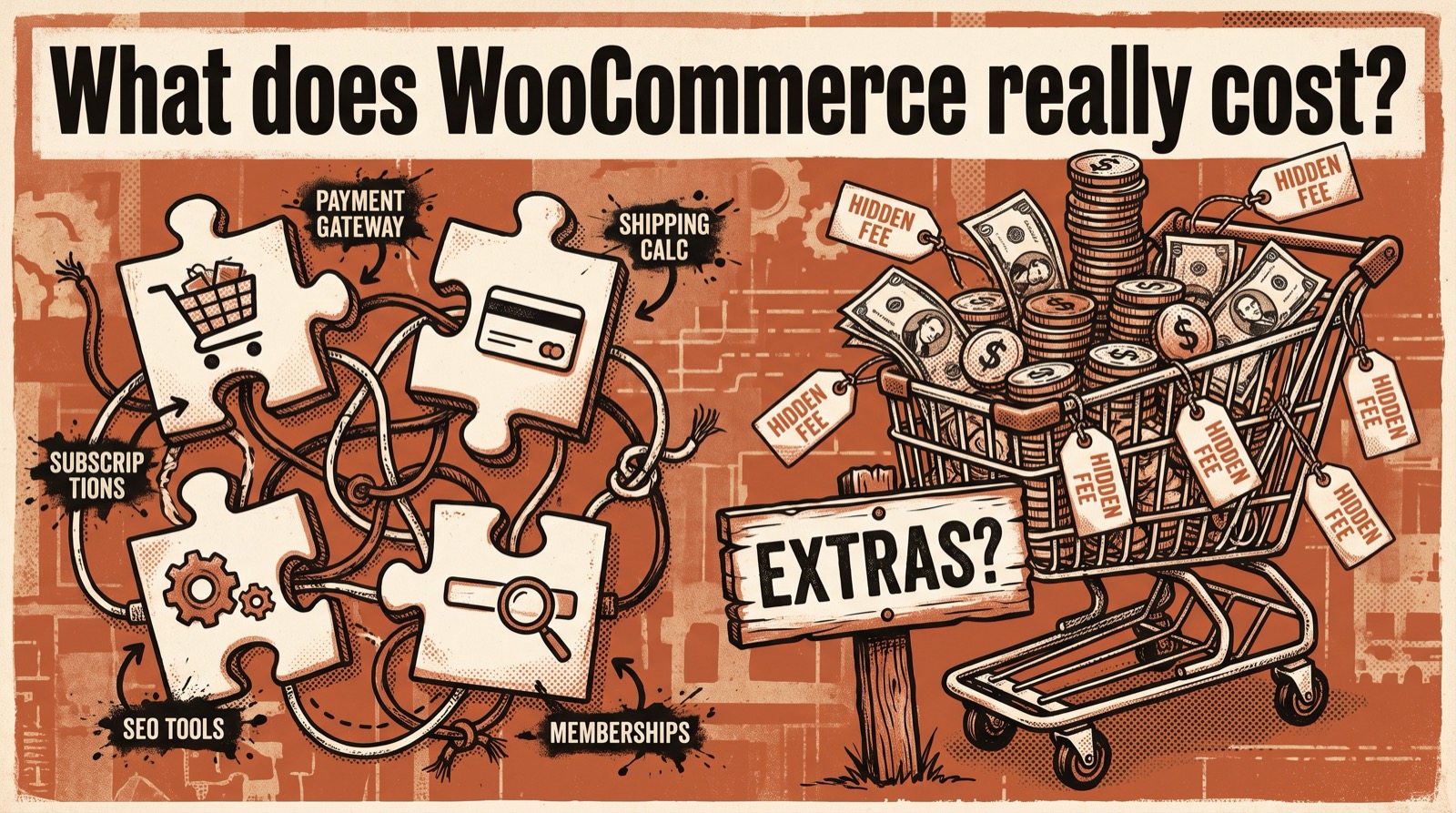
The WooCommerce core plugin is free. A store that can actually take orders is not. Independent estimates put a small professional store at 2,350 to 2,800 USD a year and a mid sized established one at 11,700 to 15,500 USD. You pay for hosting, a theme, paid extensions and above all for somebody's time on updates and security. The word free applies to the core and nothing else.
Comparison table
Compare the scope and terms described in this article.
| Item | WooCommerce (per year) | Note |
|---|---|---|
| Plugin (core) | 0 USD | open source, GPL |
| Hosting | 48 to 480 USD | shared up to managed |
| Domain | 12 to 20 USD | mandatory |
| Premium theme | 49 to 149 USD | usually needed |
| Paid extensions | hundreds of USD | Subscriptions 279, AutomateWoo 159 and so on |
| Developer / maintenance | 1,200 to 3,000 USD | around 5 hours a month |
| Small professional store total | 2,350 to 2,794 USD | Swell estimate |
| Mid sized store total | 11,734 to 15,464 USD | Swell estimate |
Amounts in USD from independent calculations (Swell), as of 2026. The payment gateway (WooPayments or Stripe) charges a further 2.9 percent plus 0.30 USD per transaction. Rough conversion at about 23 Czech crowns to the dollar.
Where the famous free part disappears
"WooCommerce is free though." I hear that sentence constantly and there is a catch inside it. What is free is the core plugin, the piece of code that turns WordPress into a shop. Everything else you need before a single customer can actually buy something has a price.
WooCommerce powers roughly a third of the world's online stores. The figures usually quoted are 4 to 4.5 million live shops and more than 7 million active installs. It is the most widespread ecommerce software on the planet and the core really is open source under the GPL. Popularity is not the same as cheap, though. It means a lot of people signed up for the word free and discovered the real cost afterwards.
What the starting bill is made of
A working WooCommerce store needs four things on day one and none of them lives inside that zero cost plugin. Hosting, because you host WordPress yourself. A domain. An SSL certificate, though most hosts now hand that over free through Let's Encrypt. And a decent theme, because the default one will not carry real selling.
Hosting is where the fork appears. Cheap shared hosting runs about 48 to 120 dollars a year and a growing store will choke on it. WordPress has a talent for slowing to a crawl as plugins pile up and badly sized photos land in the media library, which is the single most common complaint I hear from merchants. Managed hosting costs 132 to 480 dollars a year, and comfortably over 1,300 for a large store. Add 12 to 20 dollars for the domain and 49 to 149 dollars a year for a premium theme. We have not reached a single feature yet.
Paid extensions, where it stacks up
Here is where the real arithmetic starts. Out of the box WooCommerce does not do plenty of things you assume are standard, and each one is a paid extension. Product subscriptions cost 279 dollars a year. Bookings 249. Memberships 199. Marketing automation with AutomateWoo 159. Advanced shipping with Table Rate Shipping 119. Product Add-Ons 79.
Any single extension sounds harmless. The problem is that the average store buys several, and the yearly extension bill climbs into the hundreds of dollars before you notice. Watch the renewal prices too, since plenty of plugins discount the first year and go up from the second. Then the payment gateway: WooPayments or Stripe take 2.9 percent plus 0.30 dollars on every domestic transaction, and slightly more on a foreign card.
The most expensive line item is not on any price list
The costliest part of WooCommerce appears in no price list at all. It is time. Core updates, plugin updates, untangling conflicts when two extensions refuse to speak to each other, and above all security. Analyses from 2026 find that 95 percent of WordPress compromises start at a vulnerable or already compromised plugin, and supply chain attacks are rising, where an attacker takes over a legitimate plugin and ships malicious code through an update.
Somebody has to watch all of that. Either you, and then it is not money but your hours, or a developer, who by common estimates will want 1,200 to 3,000 dollars a year for around five hours of work a month at an hourly rate of 50 to 200 dollars. I will say it plainly: if you have neither a developer nor solid technical instincts, do not walk into WooCommerce expecting to save money. You save on the licence and pay on the running.
A worked estimate in three bands
An independent calculation by Swell splits WooCommerce stores into three bands and the numbers speak for themselves. A basic do it yourself store where you click everything together comes to 483 to 555 dollars a year. A small professional store already costs 2,350 to 2,794 dollars. A mid sized established one runs 11,734 to 15,464 dollars a year.
Converted roughly at 23 Czech crowns to the dollar, even that small professional store lands at about 54,000 to 64,000 Czech crowns a year, a little over 4,500 crowns a month. I am quoting the amounts in crowns exactly as the original calculation did rather than reconverting them into your currency, because an invented exchange rate helps nobody. The number that transfers is the multiple, not the sum. And that total does not buy you a supported platform, it is simply hosting, theme, extensions and work you still supervise yourself.
Where WooCommerce genuinely wins
To be clear, WooCommerce has real strengths. You hold the code and the database, nobody locks you into a proprietary platform, and the data stays yours forever. The extension and theme ecosystem is the largest on the market, and sitting on top of WordPress is a gift for SEO and for a company blog. Anyone who can code, or who has a developer, can change practically anything.
For a content led project where the shop is a sidecar to a strong blog, or for a technically confident owner, WooCommerce is a legitimate choice. I will not argue against that. Just walk in with open eyes and budget the hours, not only the licence.
When an all in one platform makes more sense
This is the gap a hosted all in one platform aims at, and the difference is philosophical. With WooCommerce you assemble a store out of plugins and carry the operations yourself. With Behio, stock, invoicing, B2B, a loyalty programme, product feeds for comparison sites and its own analytics all sit in one subscription, and hosting, updates and security are not your problem at all.
Behio Mini starts at 490 CZK a month excluding tax, or 5,880 CZK for twelve monthly payments. Higher plans add features and capacity. Behio takes no percentage of revenue and manages the hosting for you. WooCommerce costs depend on your hosting, extensions and maintenance, so compare budgets for the same business needs.
The verdict
WooCommerce is free in the core only. A working store costs time and money: 2,350 to 2,800 dollars a year for a small professional shop, over 11,000 for a mid sized one, plus gateway fees and the standing job of hosting and security. For technically confident owners and content led projects it remains a good choice. If you would rather not run a server, and you want invoicing, stock and product feeds native and with no cut of your turnover, a hosted all in one platform such as Behio from 490 Czech crowns a month saves both time and temper.
Common questions
Only the core plugin is, under the GPL. A working store needs paid hosting, a domain, usually a premium theme, paid extensions and time for maintenance. The real yearly cost runs from around 500 dollars for a do it yourself shop to 15,000 and more for a mid sized one.
Independent calculations put it at 2,350 to 2,794 dollars a year, roughly 54,000 to 64,000 Czech crowns. That covers hosting, a theme, paid extensions and part of a developer's time. It does not include a supported platform or any local features, which are further plugins.
Because security lives or dies with third party plugins. In 2026, 95 percent of WordPress compromises start at a vulnerable or compromised plugin, and attacks delivered through updates to legitimate plugins are rising. Somebody has to keep on top of it, either you or a paid developer.
It is worth it when you have a developer or the technical knowledge yourself and you are building on content, where the tie to WordPress and its blog is a genuine weapon. It is not worth it for a non technical merchant who would then pay a developer for every change and every bit of upkeep. That person is usually better off on a hosted all in one platform.
Build a store that never surprises you on the invoice.
Your own store, a clear admin and Tom there to help. Choose the features your business needs and try Behio free for 14 days without a card.