An AI chatbot can resolve 60 to 70 percent of routine questions without a human today and cuts support costs by roughly a third. In sensitive situations, meaning complaints, refunds or an angry customer, the human wins, because what decides the outcome is trust rather than speed. The best answer is hybrid: the bot takes the routine, the human takes the exceptions. Behio deliberately goes a different way from putting a chatbot on your customers. Tom, the AI partner, helps the merchant run the platform while a human answers the shoppers.
Comparison table
Compare the scope and terms described in this article.
| Type of question | Bot | Human |
|---|---|---|
| Where is my parcel | ideal, instant and at night | needlessly expensive |
| Availability, sizes | ideal | unnecessary |
| Complaint, angry customer | risk of escalation | clearly better |
| Dispute over money | unsuitable | essential |
| Availability 24/7 | yes | depends on capacity |
Figures on resolving routine questions and cost savings come from Gartner estimates (60 to 70 % of routine, costs lower by roughly a third).
What a support bot handles today
I am not going to pretend AI does not work on support. It works, and quite well. Gartner puts it at 60 to 70 percent of routine questions resolved by AI chatbots without human involvement, with support costs falling by roughly a third. Where is my parcel, what sizes do you have, how long do I have to return something, a bot handles all of that instantly and at night, when no human is sitting at the chat.
Around 42 percent of companies already use some conversational interface, and the numbers make sense. Routine questions are repetitive, have a clear answer and arrive in volume. Which is precisely where a machine beats a tired human answering the hundredth parcel tracking question without enthusiasm.
The returns tend to be decent. Estimates put AI customer service at around 3.50 dollars back for every dollar spent, largely because a human does not have to sit at a chat window twenty four hours a day. And note the second effect, because well handled purchase assistance also lifts conversion: a visit where AI helps with the choice converts markedly better than a visit without help. That is an argument for deployment which often gets overlooked, because people look only at the cost saving and not at the conversion lift.
Where a bot hits the wall
The trouble starts the moment a question leaves the well worn tracks. A complaint where the customer is angry. A dispute over a refund. A situation where something happened that appears in no script. There the bot either answers beside the point or repeats itself, which winds the person up even further than they already were.
In those situations it is not speed that matters but trust, and the feeling that on the other side is somebody who understands and can decide. A bot pretending to be human while obviously missing the point does more harm than good. The worst customer experience is not a slow reply, it is being trapped in a bot with no way through to a living person.
The hybrid model: bot on routine, human on exceptions
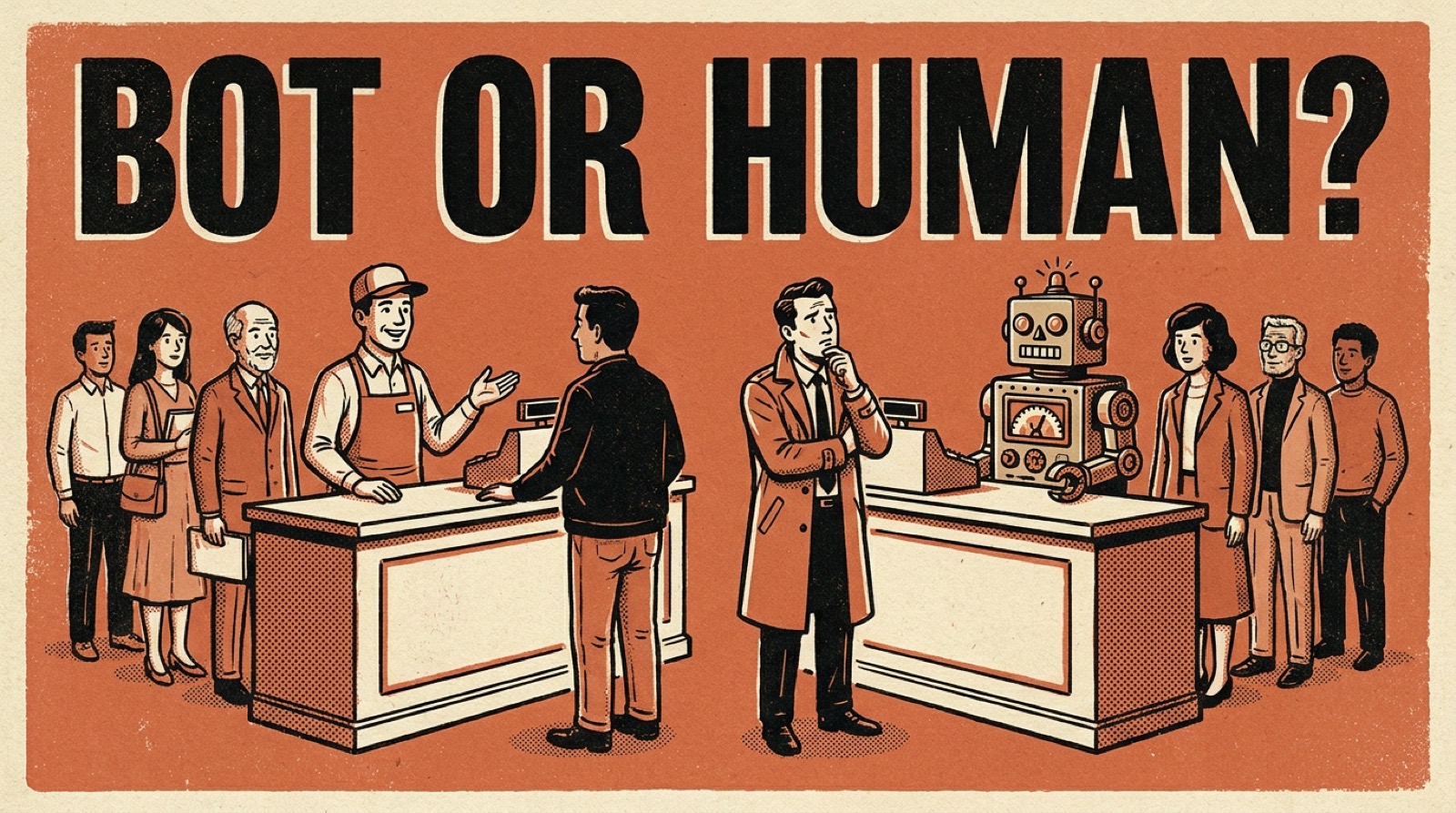
The right answer is not bot or human, it is bot and human in the right order. The bot takes the first line and the routine, where it is fast and cheap. The moment it runs into anything sensitive, or the customer starts repeating themselves, it hands over smoothly to a person, ideally with the whole context, so the customer does not have to explain from the beginning.
Two rules I would hold to. First, always leave an easy path to a living human, no hiding the button. Second, do not let the bot claim it is a person. Customers value honesty, meaning an assistant is helping you here and a colleague is taking over here, more than they value a perfect disguise. Conversion and satisfaction both rise where AI help is clearly labelled rather than where it is masked.
How Behio approaches it
Let me be straight here, because this is easy to confuse. Behio does not put a chatbot on your store to answer your customers instead of you. Tom, the AI partner, is an operator for the merchant, not for the shopper. He helps you run the platform, create products, change order states, issue invoices or read analytics, and he is available whenever you need him.
We believe a human should answer the shoppers on your store, because with a purchase, a complaint and money, trust decides. I consider saying that outright fairer than promising that a bot will solve your customer support for you. Especially given that in the Czech market, where Behio comes from, competitors often offer nothing but a phone line during office hours. Shoptet and Upgates, the two platforms most Czech online stores run on, answer from nine to five and from eight to four respectively, with no live chat anywhere. There is plenty of room there for human support, once Tom has taken the operational work off your plate so there is time for customers.
When a customer facing bot pays off
I am not writing off customer facing bots wholesale. They make sense when you have a high volume of repeated questions, clearly bounded answers and the backing for a human to take over harder cases immediately. For a large store with thousands of questions a day, that is a saving you cannot ignore.
For a smaller shop, though, I would deploy AI that speeds up operations and frees your hands so you can answer customers yourself and answer them well, rather than a bot aimed at customers. A personal reply from the owner is a competitive advantage for a small brand, not a cost to be automated away. Where AI genuinely handles operations instead of a person is covered in a separate article.
The verdict
A bot and a human are not rivals, they are two lines. The bot takes the routine, where it is fast, cheap and available at night, and for 60 to 70 percent of ordinary questions that makes sense. On complaints, money and angry customers the human wins, because trust decides rather than speed. So keep an easy path to a living person and do not let the bot pretend to be one. Behio deliberately goes the other way: Tom helps you run the platform while a human answers your customers. I consider saying that outright more honest than promising a bot that solves support for you.
Common questions
Gartner puts it at roughly 60 to 70 percent of routine questions, things like parcel tracking, availability or return windows. Support costs fall by around a third as a result. On routine work a bot is faster and cheaper than a human and it works at night.
On anything sensitive, meaning complaints, disputes over money and angry customers. There it is not speed that decides but trust and the ability to actually make a decision. A bot repeating a script in that situation winds the customer up even further.
No. Tom, the AI partner, is an operator for the merchant and helps you run the platform. We believe a human should answer the shoppers on your store, because with a purchase, a complaint and money, trust decides. We consider it fairer to say that outright.
Two rules. Always leave an easy path to a living human, no hidden button. And do not let the bot claim it is a person. Clearly labelled AI help lifts satisfaction and conversion more than a perfect disguise the customer cannot escape from.
More likely with a high volume of repeated questions and the backing to take over complex cases. For a small shop, a personal reply from the owner is a competitive advantage rather than a cost. There it makes more sense to use AI that speeds up operations and frees your hands for customers.
Build a store that never surprises you on the invoice.
Your own store, a clear admin and Tom there to help. Choose the features your business needs and try Behio free for 14 days without a card.