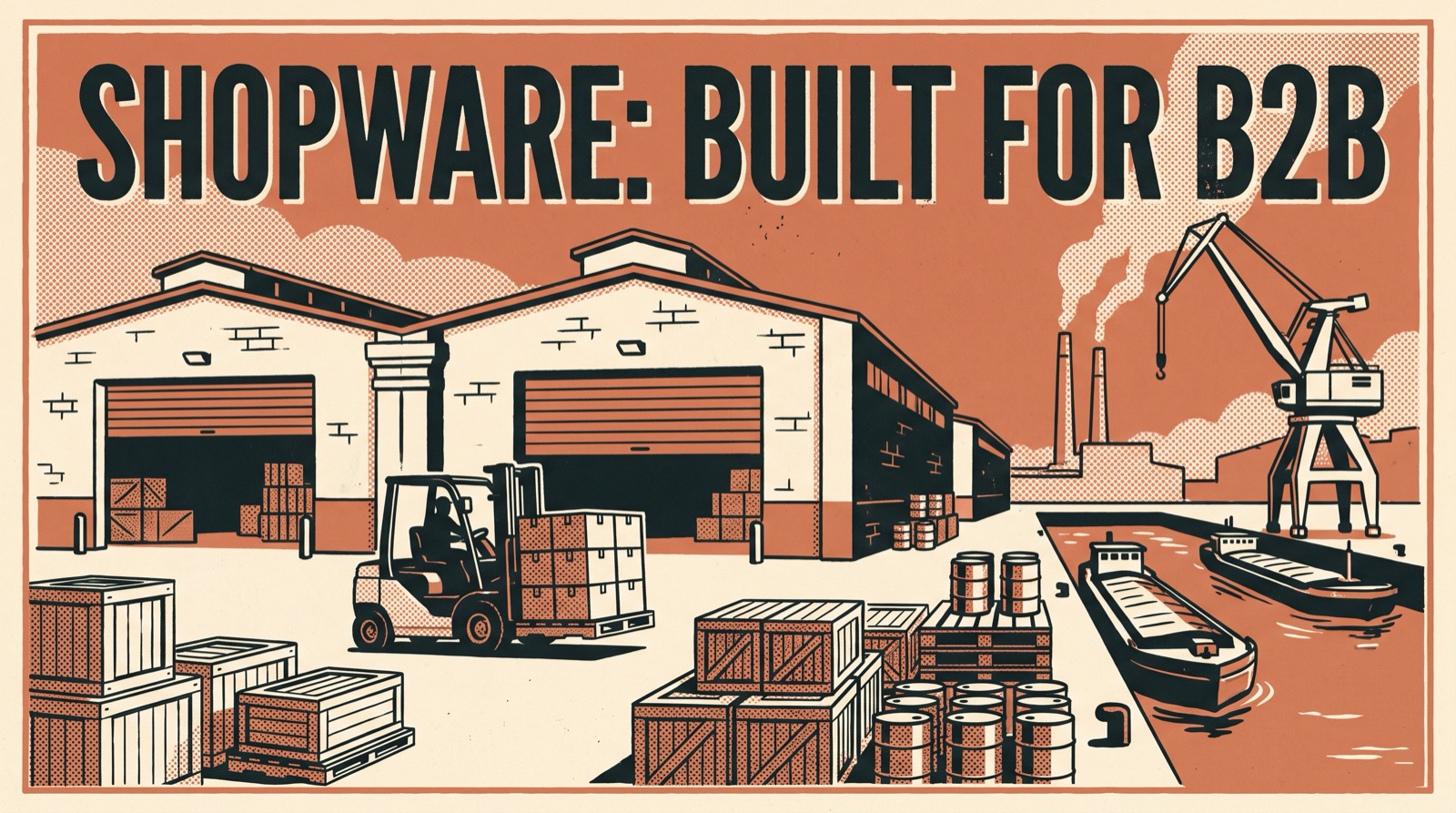
Shopware 6 is a German ecommerce platform with a commanding position across the DACH region and one of the strongest native B2B offerings in the enterprise segment. The Community edition is open source and free, but since 2025 only up to 1 million euros of annual turnover (GMV), above which a paid edition is required. Those start at 600 euros a month (Rise) and native B2B needs the Evolve edition from 2,400 euros a month. For large DACH manufacturers and distributors with an ERP and complicated pricing, Shopware is an excellent choice. Outside its home region, for an ordinary small B2C store, it is expensive and heavy to implement, with none of the local payment and carrier integrations native.
Comparison table
Compare the scope and terms described in this article.
| Edition | Price / month | Who it is for |
|---|---|---|
| Community | 0 EUR (free up to 1 million EUR GMV/year) | developers, small projects, testing |
| Rise | from 600 EUR | smaller firms wanting the official ecosystem |
| Evolve | from 2,400 EUR | native B2B Components |
| Beyond | from 6,500 EUR | enterprise, individually priced by GMV |
Prices as of 2026 from official sources, rising in bands according to turnover (GMV), with the exact boundaries unpublished. Shopware charges no commission and no transaction fee. Agency implementation is separate.
What Shopware is and where its strength lies
Try finding a Czech store running on Shopware. I tried while writing this and ran into silence. That is the first thing to understand about Shopware: it is a big player, just not everywhere.
Shopware is a German platform built on a modern architecture (Symfony, API first, headless ready). It has led the German market four years running, powers 115 of the thousand largest German stores and is used by more than 100 thousand merchants worldwide. Its centre of gravity is the DACH region, meaning Germany, Austria and the surrounding markets, and it targets everything from small D2C shops to enterprise B2B distributors.
The model has four editions: Community (free, open source), Rise, Evolve and Beyond. And the free one carries a catch worth knowing in advance.
Fair Usage Policy: free only up to a million euros
The Community edition stays open source and free, but since 2025 a Fair Usage Policy applies: it is free only up to 1 million euros of annual turnover. Above that threshold a merchant has to move to a paid edition to keep access to their Shopware Account and to the Shopware Store with its extensions.
On top of that, every Community user is required to report turnover through the Shopware GMV Reporting extension. Anyone who does not need the Shopware Store can technically run Community above the threshold, but cuts themselves off from the official ecosystem. It is communicated fairly, yet it is a fundamental difference from what people picture when they hear open source and free.
What the paid editions cost
This is where it breaks. The jump from free Community to the first paid edition, Rise, is 600 euros a month, roughly 7,200 euros a year. Evolve, which you need for native B2B, starts at 2,400 euros a month (around 28,800 euros a year) and the top Beyond edition starts at 6,500 euros a month. Prices then rise in bands according to turnover, and Shopware does not publish where those band boundaries sit.
Add implementation to the total. Agency deployment on larger projects runs into tens of thousands of dollars, and a model mid sized B2B project on Shopware is estimated at 72 to 114 thousand dollars in the first year. In fairness, Shopware itself takes no commission and no transaction fee on sales: you pay for the edition and the people around it. For a small store these are numbers from another planet.
Enterprise B2B is where Shopware shines
Let us be clear where Shopware is strong. Its enterprise B2B is among the best on the market and that is not a marketing line. The B2B Components package covers quick ordering, quote management, employee management with roles, approval rules, shopping lists and organisational units, and it can be switched on per customer or per group.
It also has a pricing engine built for negotiated B2B prices: Advanced Prices, Rule Builder and Individual Pricing handle tiered, volume, group and contract pricing without custom development. And a genuinely API first architecture connects cleanly to ERP, CRM and warehouse systems, which is what large manufacturers and distributors need. If that is what you are after and you operate in DACH, Shopware fits. If you run an ordinary wholesale operation without an ERP and organisational units, you get the whole B2B stack (customer groups, price tiers, quotes, a portal and approvals) natively in the Behio Grow plan at 2,990 Czech crowns a month, rather than from an edition costing 2,400 euros. Store Builder is in closed access; choose a ready-made template to start today.
One straight note: the older B2B Suite has been in maintenance mode since 2026 and the new B2B Components were still a work in progress early in the year, so some features from the old Suite are missing for now. It is a transition period you have to plan around.
Why it is a fringe choice outside its home region
The absence of Czech references is not a coincidence. Shopware has no native integration with the local ecosystem there, meaning the domestic payment gateways Comgate and GoPay, cash on delivery, or the Packeta, PPL and Balíkovna pickup point networks, and it has neither full Czech localisation nor invoicing that meets local requirements. All of that would have to be built as a custom integration, which means more money and another partner. Substitute your own country's rails and the same list appears.
Then there is implementation complexity. Shopware is not a simple opinionated stack where you click and go, it is a platform that for B2B demands careful scoping and an experienced implementation partner. For a German manufacturer with an ERP and an agency, that is fine. For a small merchant or a modest B2C store, it is a needlessly heavy and expensive road.
How Behio approaches it
Behio aims at a different segment than enterprise DACH B2B, but it covers a good part of that B2B need natively and without a jump to thousands of euros a month. Customer groups, price tiers, quote requests, a B2B customer portal and approval workflows are part of the platform rather than of an edition costing 2,400 euros. Paid plans start at 490 Czech crowns a month and the full B2B stack comes with the Grow plan at 2,990 crowns, still a fraction of the enterprise editions.
It is also built for the Czech and Slovak markets: local payment gateways, Packeta and Zaslat, cash on delivery, invoicing with export into Pohoda and localisation included. I am not going to claim Behio is Shopware for large German distributors, that would be a lie. But for a company that needs B2B features and does not want an expensive German edition plus a custom integration on top, it is a considerably more direct route.
The verdict
Shopware is a strong platform, just not for everyone. For large manufacturers and distributors in the DACH region with an ERP, complex pricing and serious B2B requirements, its native B2B is among the best there is. Outside that home region, for an ordinary B2C store or a smaller wholesaler, it is an expensive choice: free Community only up to a million euros of turnover, paid editions from 600 euros a month, native B2B only from 2,400 euros, and no native local payment or carrier integrations. A Czech or Slovak company that needs B2B will get there faster and cheaper with Behio, where the whole wholesale stack plus local payments and carriers sit natively in the Pro plan at 5,990 crowns a month.
Common questions
The Community edition is open source and free, but since 2025 only up to 1 million euros of annual turnover. Above that a paid edition is needed to keep access to the Shopware Account and Store. Every Community user also has to report their turnover.
Rise from 600 euros a month, Evolve from 2,400 euros a month (required for native B2B) and Beyond from 6,500 euros a month. Prices rise in bands according to turnover and Shopware does not publish the boundaries. Agency implementation comes on top, tens of thousands of dollars on larger projects.
In enterprise B2B. The B2B Components package (quick ordering, quote management, employee management with roles, approval rules, organisational units) plus a pricing engine for negotiated prices is top tier for large companies. Native B2B does require at least the Evolve edition from 2,400 euros a month, though. For an ordinary wholesaler without an ERP, Behio offers the whole B2B stack natively in the Grow plan at 2,990 Czech crowns a month.
For an ordinary B2C store, probably not. It has no native integration with local payment gateways, carriers or invoicing, it is demanding to implement and the paid editions are expensive. It makes sense mainly for large companies with a DACH footprint, an ERP and complex B2B. In Czechia, references are close to nonexistent.
Build a store that never surprises you on the invoice.
Your own store, a clear admin and Tom there to help. Choose the features your business needs and try Behio free for 14 days without a card.